How goBHB® May Signal Your Cells to Build New Mitochondria
Most people think about energy in terms of fuel. Carbohydrates provide fuel. Fats provide fuel. Ketones provide fuel. But that is only part of the story. Your c
Most people think about energy in terms of fuel.
Carbohydrates provide fuel.
Fats provide fuel.
Ketones provide fuel.
But that is only part of the story.
Your cells also have to possess the machinery required to turn that fuel into usable energy.
And that machinery is not fixed.
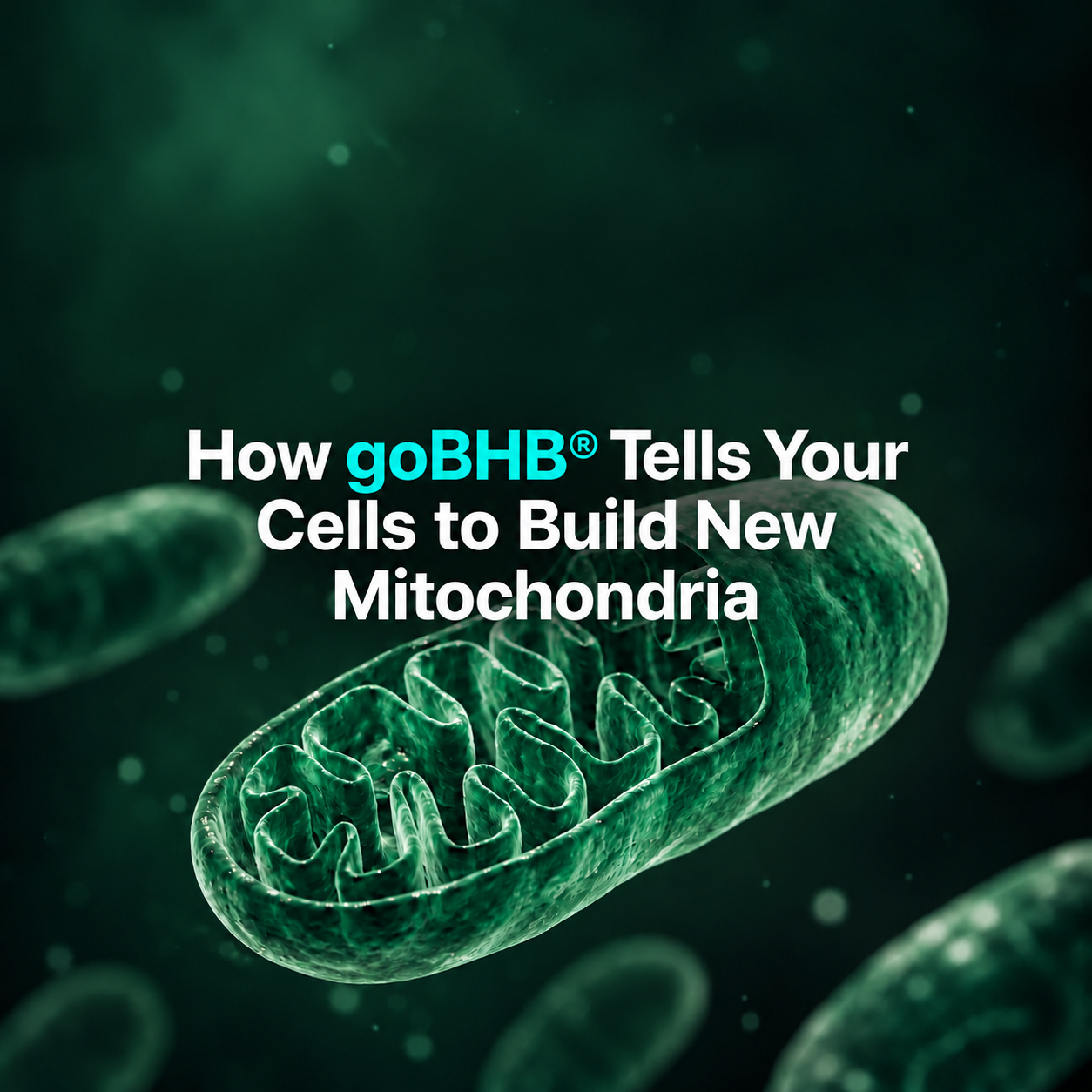
Mitochondria—the structures inside your cells responsible for much of your ATP production—can increase in number and capacity in response to certain biological signals.
That process is called mitochondrial biogenesis.
And emerging research suggests beta-hydroxybutyrate, or BHB, may do more than simply feed existing mitochondria.
It may also help activate the signaling pathways involved in building more of them.
Mitochondria Are Dynamic
Mitochondria are sometimes described as the “powerhouses of the cell.”
That description is useful, but incomplete.
They are not static structures that remain unchanged throughout life.
Cells can alter mitochondrial number, function and quality in response to energy demand.
Exercise is one of the best-known examples.
Repeated training creates signals that encourage cells to increase mitochondrial content and oxidative capacity.
In simple terms:
Demand more energy often enough, and the cell adapts by building more machinery to produce it.
At the center of that process is a network of signaling proteins, including AMPK, sirtuins and PGC-1α.
PGC-1α in particular is considered a major regulator of mitochondrial biogenesis.
Where BHB Gets Interesting
BHB has traditionally been viewed as an alternative energy substrate.
And it is.
Once inside cells, D-BHB can be converted into acetyl-CoA and oxidized inside mitochondria to help produce ATP.
But research increasingly shows that BHB is also a signaling metabolite.
That means it can influence cellular pathways beyond its role as fuel.
In cultured neurons, D-BHB has been shown to increase nuclear PGC-1α, alter the NAD+/NADH ratio and stimulate mitochondrial biogenesis in a sirtuin-dependent manner.
Other experimental work has found that BHB can activate the AMPK-SIRT1-PGC-1α pathway, a signaling axis closely associated with mitochondrial adaptation and biogenesis.
That creates an intriguing possibility.
BHB may not simply provide fuel to the mitochondria already there.
It may also help signal cells to increase mitochondrial capacity.
More Than Fuel
That distinction matters as you can imagine supplying more fuel to an engine.
That can increase the amount of energy available in the short term.
But what if the same molecule also helped signal the system to build more engines?
That is the bigger question surrounding BHB.
Researchers are increasingly investigating whether BHB acts simultaneously as:
an energy substrate
a redox regulator
a signaling molecule
and a modulator of mitochondrial adaptation
That broader role is one reason ketone research has expanded far beyond ketogenic dieting and the two shouldn’t be as associated.
These findings are promising and still need to be explored in human clinical trials.
Why This Matters for Performance and Healthy Aging
If this mechanism translates meaningfully to humans, the implications could extend well beyond acute energy.
Mitochondrial content and function matter for:
endurance
metabolic flexibility
recovery
fatigue resistance
brain energy
healthy aging
and overall oxidative capacity
This is why mitochondrial biogenesis has become such an important topic in exercise science and longevity research.
The question is no longer simply:
How much fuel can we provide?
It is also:
Can we improve the cellular machinery responsible for using that fuel?
Why goBHB®?
Mechanism research is most useful when the ingredient being studied is consistent and well characterized.
goBHB® provides a standardized source of beta-hydroxybutyrate rather than an unspecified commodity ketone powder.
Its intended food and beverage use has been independently reviewed and affirmed under GRAS standards.
That does not mean every mechanistic study on BHB automatically proves the same outcome for every goBHB® formulation or dose.
But it does mean manufacturers and researchers are working with a defined BHB ingredient rather than relying solely on a category name.
That distinction matters as ketone science continues to mature.
Fuel Today. Capacity Tomorrow?
The most exciting thing about BHB may ultimately be that it does not fit neatly into one category.
It is fuel.
But it may also be a signal.
A molecule that can be oxidized for immediate cellular energy while potentially influencing the pathways cells use to adapt to future energy demands.
That is still an emerging area of research.
But it is a compelling one.
Because if the mechanism continues to hold up, the conversation around ketones becomes much bigger than supplying another source of ATP.
It becomes a conversation about the machinery producing that ATP in the first place.
More than fuel.
A possible signal to build more engines.